
Guide · Green Cardamom · 30 Oct 2026 · 7 min read
Cardamom grades explained: 8 mm, 7 mm, AGEB and what they mean
By PureNest Ventures
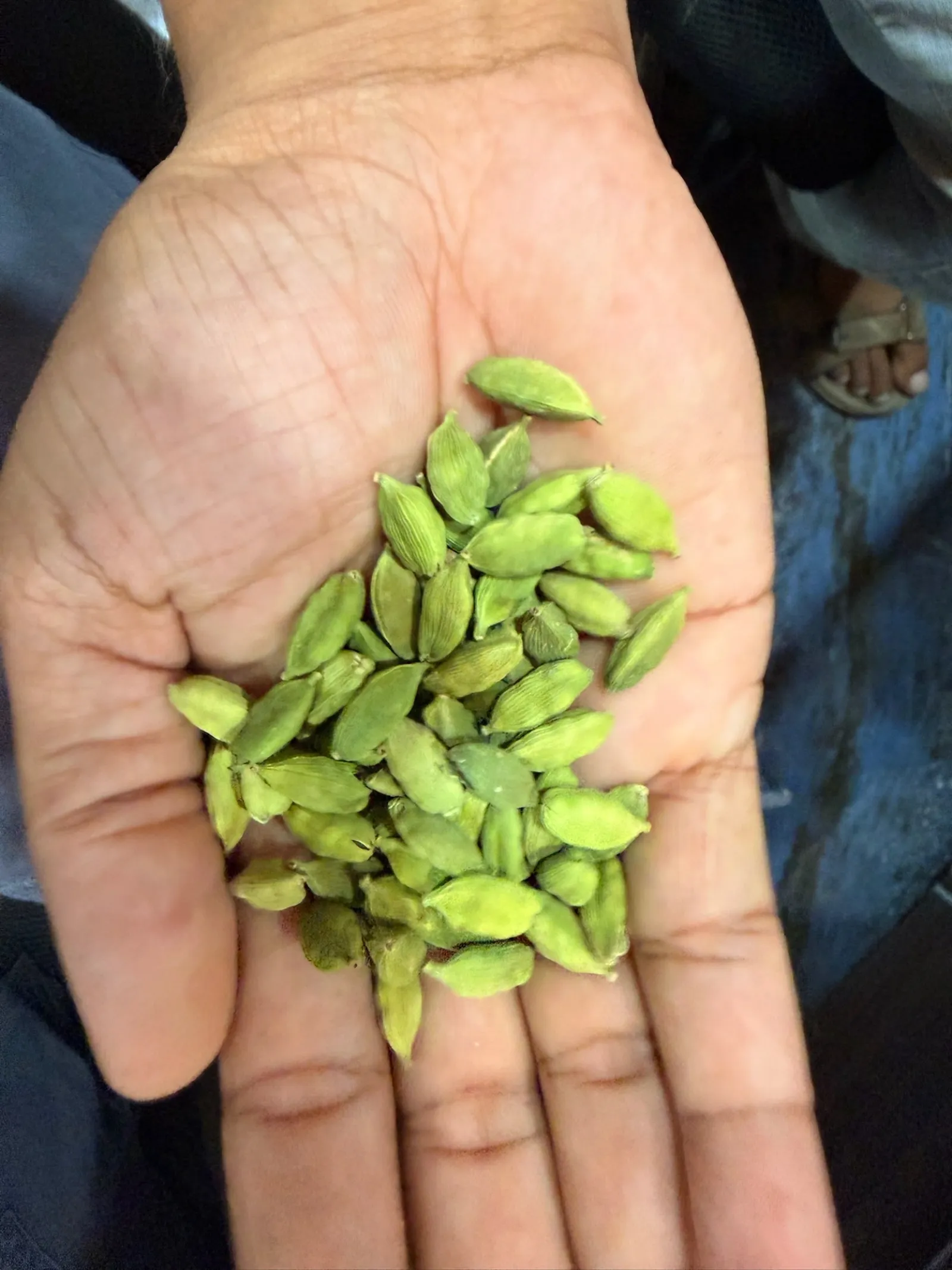
Why the same grade has two sizes
Ask three cardamom suppliers for "AGEB" and you may get three different pod sizes. The confusion is old, and it comes from two systems that use similar names.
The first is the official one. India's Warehousing Development and Regulatory Authority (WDRA) publishes the Agmark rules for whole cardamom capsules in Schedule IX. Under that schedule, a lot may carry an area mark only when it is produced in that particular area. The marks are defined by the diameter of the holes in the sieve that retains the pods:
| Agmark mark | Sieve hole diameter (pods retained) |
|---|---|
| Alleppey Green Extra Bold (AGEB) | 7.0 mm |
| Alleppey Green Bold (AGB) | 6.0 mm |
| Alleppey Green Superior (AGS) | 5.0 mm |
| Coorg Green Extra Bold (CGEB) | 8.0 mm |
| Coorg Green Bold (CGB) | 7.5 mm |
| Coorg Green Superior (CGS) | 6.0 mm |
Source: WDRA, Agmark Schedule IX, general characteristic 7 (file dated 25 August 2025).
The second system is trade usage. Exporter guides commonly describe the top grade as "8 mm and above", with the next grade at 7-8 mm and the one below at roughly 6-7 mm. One exporter guide dated 29 August 2026 puts AGEB at "approximately 8 mm and above", and adds that the Spices Board does not publish numeric specifications, so buyers should confirm each supplier's cut-offs. That is trade commentary, not a standard. A university text on spice technology (INFLIBNET, undated) lists AGEB at 7 mm and above, so published sources themselves disagree.
We can see three reasons for the gap. First, the Agmark names are area marks: the Coorg equivalent of "extra bold" is 8.0 mm, so an "8 mm extra bold" has an official home, just not under the Alleppey name. Second, the standard defines size by a sieve, while buyers often think in terms of measured pod length or a visual impression. A sieve hole diameter and a ruler reading are not the same measurement. This second point is our reading of the situation, not something either source states. Third, "AGEB" has become a trade word for "the biggest regular grade", whatever the exact cut-off.
The practical lesson is simple. Treat "AGEB" and "8 mm" as labels, not specifications. What binds a seller is the number and the measuring method written into your order.
Litre weight: a density check, not a size
Litre weight (also called bulk density or mass per litre) is the mass of loosely filled pods that fit in one litre, in grams. Heavier pods fill the litre more densely. A pod can be large but light if it is thinly filled with seed.
Public figures to know:
- The Agmark schedule sets minimum mass per litre for its two grades, Special and Standard. Reading the table in the PDF, the minimums are 435 g/L and 385 g/L respectively.
- INFLIBNET lists 435 g/L for AGEB, 415 g/L for AGB and 385 g/L for AGS. The exporter guide above gives the same three figures.
Litre weight and size usually move together, which is why a grade name often implies both. But they are tested separately. If your product depends on seed content, ask for litre weight as its own line on the order rather than assuming the grade name covers it.
Colour, clipping and the other things that grade a lot
Size is only one input. CBI, the Dutch import-promotion agency, lists the factors that grading considers: colour, clipping (trimmed pod tips), size, whether the pods are bleached, extraneous matter and origin. It also notes that the share of split or open pods and the drying method affect quality.
Colour has a formal mechanism in the Agmark schedule. Capsules may be light green, green, deep green or pale brownish, and pale cream to white when bleached with sulphur dioxide. They must be packed by colour group, the group must be shown on the label, and at least 95 per cent of the capsules must fall in that group. CBI summarises the same rule for the European market: if 95 per cent share a colour, the label states it; if colour is not uniform, it need not be stated.
So "green" on a quotation is not a measurement. A colour group, declared on the label and held to 95 per cent, is. The Agmark schedule also limits extraneous matter, empty and malformed capsules, immature and shrivelled capsules and insect-damaged matter, which is a useful checklist of what a buyer can ask to see controlled.
Rejection grades
Rejection grades are pods set aside from the main grades during sorting. We found no public standard that defines "rejection" by size or defect, so the following is a description of trade usage and not a published definition. In practice, pods that fall outside the tolerance for a main grade (for example empty, split, light or uneven pods) may be sold separately, often within the same size bands. They suit uses where appearance matters less than flavour, such as grinding or further processing, but that depends entirely on what the lot contains.
Because the term has no official definition, do not accept "rejection" on its own. Ask what the lot excludes from the main grade and what defects it can contain, and have that described in the agreed product specification.
How to write a grade on a purchase order
A grade line that leaves little room for dispute covers the following:
- Product and form. Green cardamom, whole capsules (not seed).
- Origin. The growing region you are paying for.
- Size grade and the way it is measured. For example "7-8 mm, measured by sieve" or "measured pod length", not just "AGEB".
- Litre weight. A minimum in g/L, if your use depends on it.
- Colour group. One of the Agmark colour groups, declared on the label.
- Defect limits. Extraneous matter, empty or malformed pods, shrivelled pods and insect damage.
- Reference standard, if any. For example Agmark Schedule IX, or the applicable Indian or ISO standard that CBI cites (IS 1987:1984, ISO 882-1).
- Documents. What accompanies the lot, and how a tested lot is identified.
If a supplier's grade name and your own reading of it differ, the order should say which governs. When in doubt, ask for a sample drawn from the lot to be measured against the line you wrote.
PureNest grades at a glance
PureNest supplies Idukki green cardamom as whole pods. The grades are described by size.
| Grade type | Size | Format | Origin |
|---|---|---|---|
| Size grade | 6-7 mm | Whole pods | Idukki, Kerala |
| Size grade | 7-8 mm | Whole pods | Idukki, Kerala |
| Size grade | 8 mm+ | Whole pods | Idukki, Kerala |
| Rejection grade | 6-7 mm | Whole pods | Idukki, Kerala |
| Rejection grade | 7-8 mm | Whole pods | Idukki, Kerala |
| Rejection grade | 8 mm+ | Whole pods | Idukki, Kerala |
The grades are named by size and are not presented as Agmark marks. Appearance may vary by lot.
How PureNest can help
Our green cardamom comes from Idukki, Kerala, as whole pods in the three size grades above, with rejection grades in the same three sizes. Tell us the grade, quantity and packing you need, and we will send a quotation for your destination. Request a quotation from this page and we will take it from there.
A product specification is agreed and shared with every quotation. Batches and lots are tested regularly by authorised laboratories, based on production and sourcing. A Certificate of Analysis (COA) is issued for each tested batch or lot. Every shipment comes with a Certificate of Origin issued by the chamber of commerce. Our quality page describes these documents, and you can see the grades on the green cardamom product page.
Sources
- WDRA, Agmark cardamom grading rules, Schedule IX (PDF) — 25 Aug 2025
- CBI, Entering the European market for cardamom (market entry) — 19 Feb 2025
- INFLIBNET, Technology of spices and condiments, ch. 18 Cardamom: Grading (accessed 30 Oct 2026, undated) — 30 Oct 2026
- Shree Agro International, Cardamom grading 8mm 7mm explained (exporter commentary) — 29 Aug 2026
What PureNest provides: product specification, Certificate of Analysis and Certificate of Origin.
More insights
- Buying cardamom and spices in bulk for hotels, restaurants and cafés
Guide · 30 Oct 2026
- New-crop cardamom 2026: what the auctions and a dry monsoon mean for buyers
Market · 30 Oct 2026
- Zero extra US tariff on Indian spices: what changes for US importers
Market · 30 Oct 2026